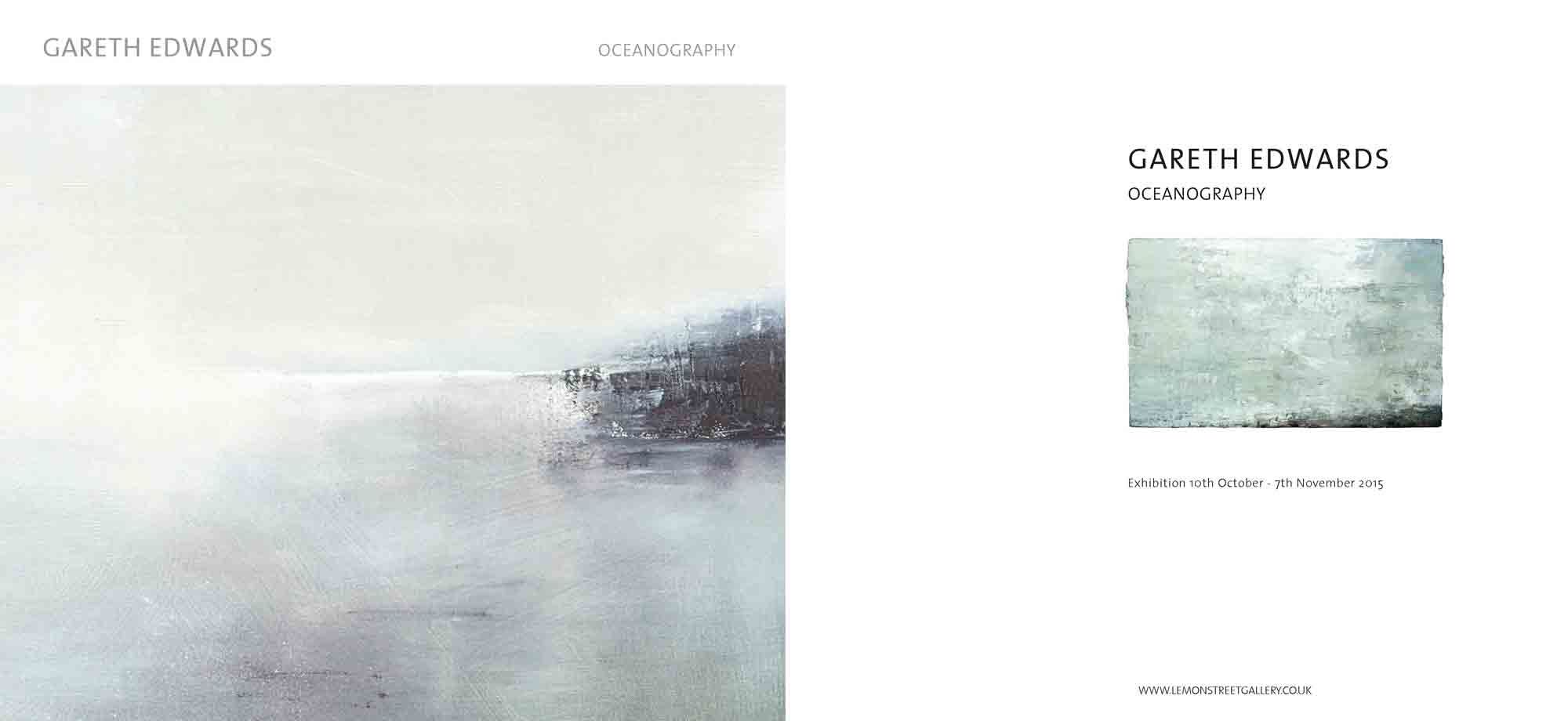
Oceanography
content
10th October to 7th November, 2015content
10th October to 7th November, 2015


Gareth Edwards’ paintings gift to us the luxury of endless space and solitude. Through the stripping away of material reality, they allow us to stand unhindered at the boundary of self, to look outward across an internal world, a liquid plane of shifting beauty, thought and feeling.
As a child Edwards was given a Larousse Encyclopaedia of Oceanography, and at the image of an immense tidal wave experienced a ‘sublime terror’ which never left him. In his adulthood, years spent chasing the echoes of some richer, more vivid inner life finally drew him back to an intense and revelatory relationship with the sea.
In the quiet of his studio, paintings hang dreamlike in the tranquil aftermath of intense emotional engagement between painter and canvas. Here, on the slim peninsula of land that joins St Ives town with the Island, the surrounding ocean has seemingly poured in through high north-facing windows, drenching floorboards, walls, table tops and idle brushes in a tide of oceanographic colour. Soaked with this same, mineral palette, each canvas contains within its limitless depths a fluid meteorology of the mind: gentle, joyful, brooding, ominous. In a reductive style that falls outside the common boundaries of visual description, these paintings guide us to the line where land and sea meet, and where human potential is mirrored in the eternal fluidity of water, air and light. Within the edges of each canvas Edwards renders a vast interior space, a theatre of endless emotional possibility. Painted wet in wet with hand, knife and brush, Old Holland Blue, Warm Grey and Raw Umber give ground to emerging, incidental tones of purple, mauve and gold. Turps, stand-oil and quick dry medium all play their part on a nebulous surface where depth of field is mere trickery, and matters of perspective are left entirely to the interpretation of colour. Without irony, Edwards refers to himself as a ‘contemporary landscape painter’, and his achievement is in the conjuring up of something familiar, yet entirely unknowable: indistinct forms emerge and retreat, horizons transpire and vanish, and all the while the picture plane falls backwards into the solipsistic void. In Islands of the Floating World verticals and horizontals shift and change; the soft light of some distant entity, the sun perhaps, or the centre of all things, casts its blissful warmth into a shifting, shimmering realm that is neither surface nor space. The Other Side of Silence, Written on Water confronts us, not with things that are known, but with ideas of reflection, of reflective thought. Stepping lightly around the definition of both landscape and abstraction, these paintings invoke the vaporous, atmospheric nature of Turner’s later works, where illusionism gives way to the seductive delight of pure potential. In their simplicity, these paintings evade the authority of grand ideas in favour of subjective appreciation; to view them is a private and wholly personal experience. As layer falls upon layer, we respond instinctively to the emotional weight inherent in each gestural mark, each glowing colour. Like music and poetry, they resonate strongly with the human heart and echo with the artist’s many lyrical and literary influences. Listen closely to hear the luminous, spacious music of Steve Reich’s Desert Song, where single notes fall like raindrops and voices tumble over each other in a cascade of sound; the ebb and flow of St Hildegard of Bingen’s reverential Benedictine music; the rise and fall of Beethoven’s last string quartet and amongst his favourite poets, the fire and brimstone of Tom Paulin, the human compassion of Paul Muldoon, the romance and metaphor of Amy Clampitt and the lucid imagery of Alice Oswald.
Through rhythms and compositions as lilting and beautiful as the work of these writers and composers, Edwards’ paintings explore the splendour of both the literal and emotional landscape. In this collection of pure works, which imply almost nothing, freedoms are endless and the concept of beauty is ours for the taking.