Aspect
Amelia Humber6th May to 3rd June, 2017


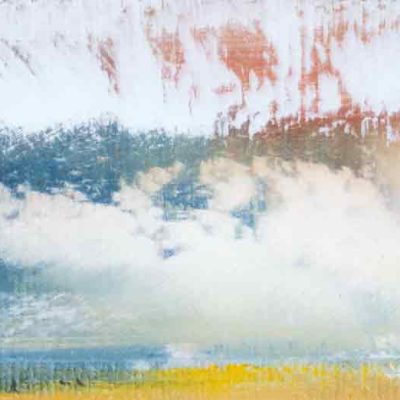


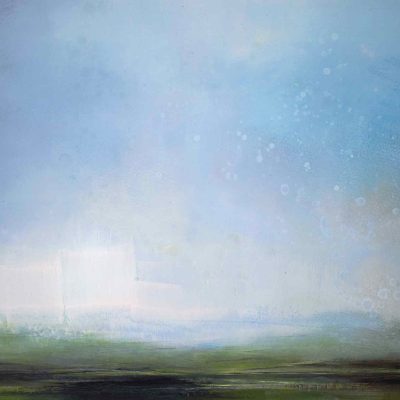

As far back as she can remember Amelia Humber has had a love of wild, untamed places. Throughout her student years at Falmouth she enjoyed nothing more than being outside in the landscape. She relished the opportunity to discover hidden sites, to get to know them better and to record how the landscape changed with different light and weather conditions.
Her responses were recorded in pencil sketches, pastel drawings and photographs. This working method has been carried through to her current practice, with notes and sketches brought back to her London studio in order to complete the oil paintings on paper, board or canvas.
At the outset it is important to acknowledge that Amelia is not concerned to produce a topographical image of a specific place. Her priority is to record her response to the multi-sensory dimensions of landscape; to capture the special moment when light, colour, texture and movement come together to produce a dramatic and, at times, apocalyptic vision. This pursuit of the intangible is a significant artistic challenge requiring technical experimentation and creative risk. In addition, it demands an intense period of reflection and critical judgment in order to produce something approaching the potency of the sublime rather than simply recording the picturesque.

Inevitably, there are occasions when contemporary painters of the landscape are frustrated by casual comments that ‘…one can see…’ a link between their work and the way artists in the nineteenth century perfected a Romantic interpretation of the English landscape. Although Amelia has studied the techniques and vision of major figures like Constable and Turner, it was a much more contemporary artist who shook her visual sensibilities and made her reflect on why she was so drawn to the landscape for inspiration. Len Tabner’s elemental, semi-abstract landscapes were often painted outdoors in difficult terrain and in extremes of weather.
Born in 1936, in the North East of England, Tabner’s passionate work demonstrates how the English landscape can be re-interpreted to reflect the huge political and social changes of the twentieth century. Amelia was particularly impressed with Tabner’s ability to convey atmosphere and raw emotion.

Since leaving college Amelia has spent extended periods of time exploring distinct geographical locations – Scotland, Cornwall, Sussex and more recently, Yorkshire. Although very different in scale and drama, each of these locations offers a rich and diverse challenge to a critical visual imagination. Favoured locations include the west coast of Scotland from Ullapool to Oban (especially the Applecross peninsula), Port Isaac, Helford Passage and The Lizard in Cornwall, West Wittering beach and surrounding coastline in West Sussex. Perhaps the link between these spectacular locations is that they offer a variety of landscapes, big skies and an almost overwhelming sense of isolation, grandeur and timelessness. Amelia’s preference for remote inland locations with tracts of moorland, rivers and tributaries are further evidence of a continuing engagement with the overlooked and forgotten. An obsession with the quality of light, a love of dark stormy weather and a real pleasure in refining the painterly quality of each work suggest an artist who will not be easily satisfied. Her sensitivity and response to different locations fuels her exploration of the forms and palette that determine the unique character of each place. As a result Amelia recognises that her visual language is in a state of constant evolution. She is attracted and excited by the idea of ‘creating snapshots across the UK’.
Her painting technique is delicate, difficult to control and unpredictable. Working with very thin oil paints she builds up multiple layers of paint, with each layer needing to be fully dry before starting on the next. The essential wetness of this technique requires some works to be produced on the flat in order to control the drips and pools of paint. A palette knife is utilised for bolder areas and to build up more solid areas of colours. The different stages of the journey involved in the production of each work enable the development of a number of paintings at the same time. Amelia believes that this meticulous process ‘allows the works to influence each other and encourages a continuous development’.
When I viewed Amelia’s work at her first LSG exhibition (May 2016) it was obvious that here was an artist with an innate sensitivity to place, climate and terrain. When confronting individual works, particularly the larger canvases, the intensity of colour and fluidity of technique conveyed the drama of the fleeting moment. The viewpoint was central and panoramic. Never off-centre, never close up. It was a challenge for the eyes to accommodate such an all-consuming, majestic vista.
The work for this current exhibition appears to be edging towards a greater abstraction. Whilst the title of each painting signifies location, there are very few details indicating the specific viewpoint selected by the ar tist. Overall one is left with a profound sense of place. Memory and emotion are deeply embedded in Amelia’s process of picture making.
This process is evident in ‘Tempar’ a brooding and meditative work. Demanding engagement, the image is barely contained within the confines of the picture frame. It recalls memories of similar days elsewhere – foreboding and austere. There is a strong sense of stripping bare, in order to expose a human response of awe and wonder.
For some people the very act of engaging with, or viewing, the landscape has connotations of escapism and the naive pursuit of a pastoral ideal. Whilst few would argue with the spiritual benefits to be gained from the quiet contemplation of natural beauty it has to be balanced by an understanding of the raw and terrifying power of nature. For me ‘Ratagan’ manages to convey this strong sense of threat and expectancy. Dark, fluid, and uncertain, one can almost experience the movement of the wind and the transient light. A strong filmic quality demands the viewer’s focus and concentration. It says much about the artist’s vision that this mesmeric image can suggest such a diverse range of interpretations. The work in this exhibition invites us to see, rather than just look at, our favourite locations. Amelia’s work celebrates the unexpected twists and turns of being immersed ‘in’ the landscape rather than simply engaging through a passive, distant gaze.
At a deeper, psychological level these paintings encourage reflection on our constant need for a creative and sustainable relationship with landscape.
The artist’s determination to develop her visual language, together with her pursuit of new locations, will ensure that her work remains strong and challenging. It will also continue to surprise and delight.
Professor Alan Livingston, Rector, University College Falmouth (1987-2009), 2017.
